Les hommes ont oublié cette vérité. Mais tu ne dois pas l'oublier, dit le renard. Tu deviens responsable pour toujours de ce que tu as apprivoisé.
Le Petit Prince, chap. 21
Showing posts with label village dogs. Show all posts

Saturday, 8 October 2016

nteractions between domestic and wild carnivores around the greater Serengeti ecosystem

Craft, M. E., Vial, F., Miguel, E., Cleaveland, S., Ferdinands, A., & Packer, C. (2016). Interactions between domestic and wild carnivores around the greater Serengeti ecosystem. Animal Conservation.

The domestic and wild carnivore interface is complex, yet understudied. Interactions between carnivore species have important implications for direct interference competition, cross-species transmission of shared pathogens and conservation threats to wild carnivores. However, carnivore intraguild interactions are hard to quantify. In this study, we asked 512 villagers residing around a conservation area in the Serengeti Ecosystem, Tanzania, to report on the presence of wild carnivores in their village, the number of domestic dogs Canis familiaris and cats Felis catus in their household and interactions between domestic and wild carnivores. Wild carnivores are abundant near households surrounding the Serengeti National Park, villagers have many free-ranging domestic dogs (and would like to have more) and direct and indirect contacts between wild and domestic carnivores are common. Large carnivores, such as spotted hyenas and leopards, often killed or wounded domestic dogs. Small carnivores, such as mongoose, bat-eared fox, serval and wildcat, are locally abundant and frequently interact with domestic dogs. We demonstrate that interspecific carnivore behavior, human culture and local and regional geography play a complex role in domestic and wild carnivore interaction risk around conservation areas. Through the use of household surveys, we were able to efficiently obtain data on a wide scope of carnivore interactions over a large area, which may provide a direction for future targeted and in-depth research to reduce interspecific conflict. Improving the health and husbandry of domestic animals and reducing the unintentional feeding of wild carnivores could reduce dog–wildlife interactions and the potential for pathogen transmission at the domestic–wild animal interface.

Sunday, 3 July 2016

Potential transmision of dog pathogens to wild carnivores in India

Chaudhary, V. (2016). Threats of Disease Spillover from Domestic Dogs to Wild Carnivores in the Kanha Tiger Reserve, India. MSc disertation  Graduate School of Clemson University.

Many mammalian carnivore species persist in small, isolated populations as a result of habitat destruction, fragmentation, poaching, and human conflict. Their small numbers, limited genetic variability, and increased exposure to domestic animals such as dogs place them at risk of further losses due to infectious diseases. In India, dogs ranging from domestic to feral are associated with villages in and around protected areas, and may serve as reservoirs and vectors of pathogens to the carnivores within. India’s Kanha Tiger Reserve (KTR) is home to a number of threatened and endangered mammalian carnivores including tigers (Panthera tigris), leopards (Panthera pardus), wolves (Canis lupus), and dhole (Cuon alpinus). It also contains hundreds of small villages with associated dog populations, and my goal was to determine whether these dogs pose a disease threat to KTR’s wild carnivores. In the summer of 2014 and again in the winter of 2015 I estimated the density of dogs in villages of varying sizes and distances from KTR’s core zone, and the exposure of these dogs to four pathogens that could threaten wild carnivores: rabies, canine parvovirus (CPV), canine distemper (CDV), and canine adenovirus (CAV). Dog population densities ranged from 3.7 to 23.7/km2(14 to 45 dogs/village), and showed no systematic variation with village area or human population size. These dog populations grew in all villages between the summer of 2014 and winter of 2015, primarily through reproduction. No dog tested positive for rabies but I found high levels of seroprevalence to the other three pathogens: CPV (83.6% in summer 2014,
68.4% in winter 2015), CDV (50.7% in summer 2014, 30.4% in winter 2015) and CAV (41.8% in summer 2014, 30.9% in winter 2015). The declines in seroprevalence between summer and winter were primarily due to births in the population, of animals not exposed to the viruses. I opportunistically documented interactions between the dogs and wild carnivores that might allow disease transmission. I measured these interactions as the presence of wild carnivores in surveyed villages. In this study I document the existence of a large population of unvaccinated dogs in and around KTR, with high levels of seroprevalence to pathogens with broad host ranges. These dogs also have frequent contact with wild carnivores. I conclude that these dogs pose a high risk of disease spillover to wild carnivores in the region.
I also tested for CPV and CDV in wild carnivore samples obtained from the KTR Forest Department from 2010 to 2015. While one tiger blood sample was seropositive for CPV antibodies, the reverse transcriptase polymerase chain reaction found no evidence of CPV in tissue samples from five tigers, one leopard and one palm civet (Paradoxurus hermaphroditus), and no CPV or CDV in the three blood samples of tigers. Despite these results, I argue for continued surveillance in KTR, given the ubiquity of village dogs in the area with high seroprevalence of CDV and CPV and the contact between dogs and endangered carnivores in KTR. 

Saturday, 3 October 2015

Do scavenging dogs still prefer meat?

Bhadra, A., Bhattacharjee, D., Paul, M., Singh, A., Gade, P. R., Shrestha, P., & Bhadra, A. (2015). The meat of the matter: a rule of thumb for scavenging dogs?. Ethology Ecology & Evolution, 1-14.

Animals that scavenge in and around human settlements need to utilise a broad range of resources, and thus generalist scavengers are likely to be better adapted to human-dominated habitats. In India, free-ranging dogs (Canis lupus familiaris) live in close proximity with humans in diverse habitats, from forest fringes to metropolises, and are heavily dependent on humans for their food. It has been argued that the ability to digest carbohydrates was one of the driving forces for dog domestication. Though dogs are better adapted to digest carbohydrates than other canids, pet dogs show a clear preference for animal proteins. Our observations on streets of urban and semi-urban localities show that the free-ranging dogs are scavengers which primarily receive carbohydrate-rich food from humans. Their source for animal protein is typically garbage bins and leftovers, and such resources are rare. Using a series of field-based experiments, we test if the free-ranging dogs have adapted to a generalist scavenging lifestyle by losing preference for animal protein. Our experiments show that the free-ranging dogs, which are descendants of the decidedly carnivorous gray wolf (Canis lupus lupus), have retained a clear preference for meat, which is manifested by their choice of anything that smells of meat, irrespective of the actual nutrient content. The plasticity in their diet probably fosters efficient scavenging in a competitive environment, while a rule of thumb for preferentially acquiring specific nutrients enables them to sequester proteins from the carbohydrate-dominated environment.

Friday, 26 December 2014

Some cases of stray and village dogs' attack to wild ungulates in wildlife reserves in India

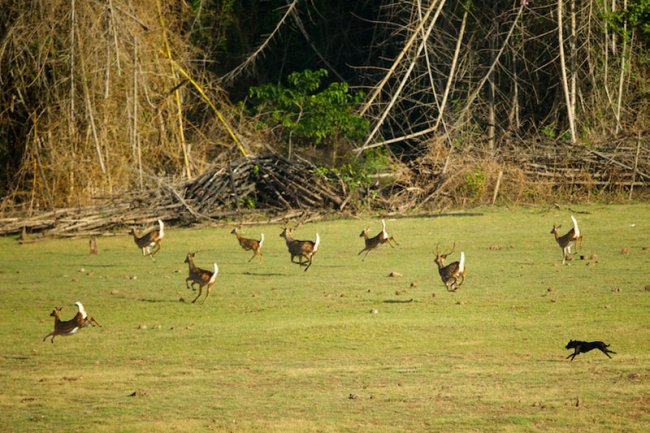
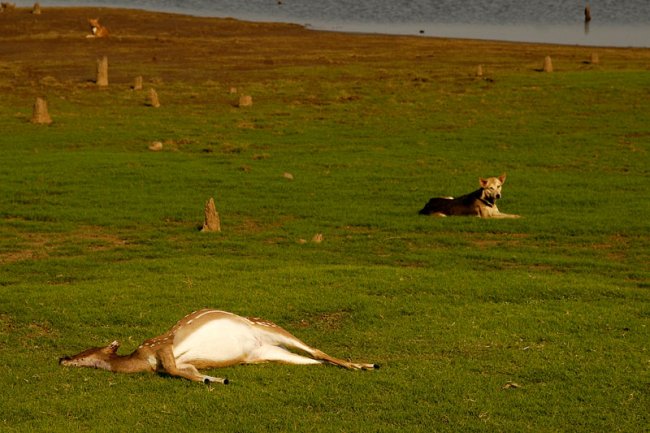
Two village dogs resting after bringing down a chital

Village Dogs Hunting Chital, Nagarahole Tiger Reserve

A pack of stray dogs attacking a nilgai in Sultanpur Wildlife Sanctuary, near New Delhi


Friday, 14 November 2014

Model to understand multispecies disease transmition between domestic and wild canids

Belsare, A. V., & Gompper, M. E. (2015). A model-based approach for investigation and mitigation of disease spillover risks to wildlife: Dogs, foxes and canine distemper in central India. Ecological Modelling, 296, 102-112.

Multi-host pathogens can pose a serious conservation threat when free-ranging domestic animal populations occur alongside susceptible populations of wild species. An example is canine distemper virus (CDV), which can occur at high prevalence in domestic dog (Canis familiaris) populations from which it may be transmitted (spillover) into wild carnivore populations. Effective management of such disease threats is hindered by our limited understanding of the the dynamics of interspecific CDV transmission in natural settings. We used a modeling approach to better understand CDV spillover threats to wild Indian foxes (Vulpes bengalensis) occurring in a protected grassland habitat in central India. An agent-based stochastic simulation model was built, and parameterized with data from ecological and epidemiological studies. Based on the sensitivity analyses of the model, the CDV incidence rate in dogs was most influenced by the proportion of roamer dogs in the dog population. The CDV incidence rate in dogs was also sensitive to the CDV introduction frequency in the dog population. The proportion of roamer dogs in the dog population also influenced the number of CDV spillover events. The basic reproductive number (R0) for CDV in the model fox population was 0.85, indicating that CDV could not be independently sustained in the fox population. We used the model to explore potential management strategies to mitigate the risk of CDV spillover. Vaccination of local dog populations was an ineffective disease control strategy, while fox vaccination was highly effective. Interventions potentially resulting in lower contact rates between dogs and foxes, like reduction in village dog density and restricting dog movements in fox habitat, implemented in a sustained and integrated manner would be most effective in mitigating disease threats to foxes. Such modeling approaches can be used to better understand disease threats for other species of management concern, and to contrast potential management interventions.

Tuesday, 16 September 2014

Leopards prefer dogs in India

Athreya, V, M. Odden, J.D. C. Linnell, J. Krishnaswamy & K. U. Karanth 2014. A cat among the dogs: leopard Panthera pardus diet in a human-dominated landscape in western Maharashtra, India. Oryx, DOI: http://dx.doi.org/10.1017/S0030605314000106 :1-7

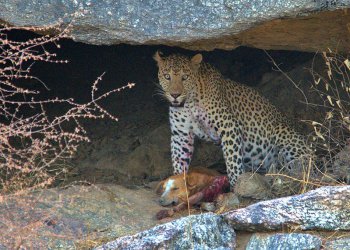
Leopard with its dog prey (Photo Gaffar Khan) 
The ecology and predator–prey dynamics of large felids in the tropics have largely been studied in natural systems where wild ungulates constitute the majority of the prey base. However, human-dominated landscapes can be rich in potential prey for large carnivores because of the high density of domestic animals, especially in tropical countries where pastoralism is an important livelihood activity. We report the almost complete dependence of leopards Panthera pardus on domestic animals as prey in the crop lands of Ahmednagar district, Maharashtra, India. From analysis of 85 confirmed leopard scats, 87% of the leopard's prey biomass consisted of domestic animals, with 39% consisting of domestic dogs Canis lupus familiaris alone. The only wild species that occurred in the leopard's diet were rodents, small indian civet Viverricula indica, bonnet macaque Macaca radiata and other primates Semnopithecus spp., mongoose Herpestes spp., and birds. Interviews conducted in 77 households distributed randomly in the study area documented a high density of domestic animals: adult cattle Bos taurus, calves, goats Capra aegagrus, dogs and cats Felis catus occurred at densities of 169, 54, 174, 24 and 61 per km2, respectively. Ivlev's electivity index indicated that dogs and cats were over-represented in the leopard's diet, given the higher densities of goats and cattle. The standing biomass of dogs and cats alone was sufficient to sustain the high density of carnivores at the study site. Our results show that the abundance of potential domestic prey biomass present in human-use areas supports a relatively high density of predators, although this interaction could result in conflict with humans.

Tuesday, 15 July 2014

Dog scavenging sea-turtle nests

Ruiz‐Izaguirre, E., Woersem, A., Eilers, K., Wieren, S. E., Bosch, G., Zijpp, A. J., & Boer, I. J. M. (2014). Roaming characteristics and feeding practices of village dogs scavenging sea‐turtle nests. Animal Conservation.

Village dogs are reported to prey on sea-turtle nests at various beaches worldwide. Sea-turtle species present in Mexico include six species, which are listed under the International Union for Conservation of Nature Red List. It is however not clear why dogs scavenge and how they enter nesting areas; this hinders effective management of dogs at sea-turtle nesting beaches. Hunger, for example, could be a driving factor for village dogs to scavenge sea-turtle nests. The aim of this study was to gain insight into roaming characteristics and feeding practices of dogs scavenging sea-turtle nests. Movements of 19 village dogs (9 nest scavengers and 10 non-nest scavengers) at Colola village and beach (an important nesting ground for the eastern Pacific green turtle: Chelonia mydas) were monitored through radio-tracking and direct observations. A prerequisite for nest scavenging is traveling to the beach. We computed ‘distance from home to beach’ and ‘the activity range’ of nest scavengers and non-nest scavengers. Furthermore, the dogs' owners were interviewed regarding feeding practices. Nest scavengers had a lower metabolic energy intake of their daily food corn tortillas (296 kJ kg−1 BW0.75) than non-nest scavengers (464 kJ kg−1 BW0.75) (two-sample t-test=2.67, P=0.017). Moreover, 39% of owners reported that they provided turtle eggs or egg shells to their dogs at least once. The activity range of nest scavengers was significantly larger than that of non-nest scavengers (F=11.64, P=0.007). Dogs were generally found at the beach at night (42%) and dawn (34%). Our findings have implications for the management of dogs at sea-turtle nesting beaches. We recommend that dogs' movements should be restricted between night (09:00 pm) and dawn (06:00 am) and that sufficient and adequate feeding of dogs should be promoted among dog owners.

Monday, 14 July 2014

Perception of village dogs by villagers and tourists

Ruiz-Izaguirre, E., & Eilers, C. H. A. M. (2012). Perceptions of village dogs by villagers and tourists in the coastal region of rural Oaxaca, Mexico. Anthrozoos: A Multidisciplinary Journal of The Interactions of People & Animals, 25(1), 75-91.

The objective of this study was to gain an understanding of the village dog-keeping system, and of perceptions of dog-related problems by villagers and tourists, in the coastal region of Oaxaca, Mexico. We conducted a survey of the inhabitants of three villages (Mazunte, Puerto Angel, and Río Seco), whose main economic activities were tourism, fishing, and farming (n = 99), and a survey of tourists (n = 151). Dogs were the most commonly kept animals in all the villages. Cultural and economic aspects were reflected in dog-keeping practices. All dog owners allowed their dog(s) to roam free in the farming village (Río Seco), but not in the tourist villages (Mazunte and Puerto Angel). Significantly more dog owners in the tourist village of Mazunte mentioned companionship as a reason for keeping dogs than those in the farming village. All villagers perceived as a problem that there were too many dogs. The mean number of dogs per household was 1.8, and there were significantly more male dogs in the farming village than in the tourist villages. Efforts to control the dog population in the rural coastal region are aimed at rabies prevention or wildlife protection, whereas this study revealed that these issues were far less often mentioned by local people as other dog-related problems. Significantly more villagers in the tourist villages perceived there to be dog-welfare problems than those in the farming village. Significantly more North American and European tourists were concerned about dog welfare than Mexican tourists. Despite significant differences in dog-keeping between the tourist and farming villages, opinions of villagers in regard to dog breeding and methods of dog population control were similar. Villagers agreed on dog sterilization to control the dog population, but also considered that female dogs should breed at least once in their lifetime. Those living in tourist villages could benefit from improving dog welfare and implementing strategies to lessen the problems dogs cause tourists.

Thursday, 27 February 2014

Behaviour of village dogs in coastal Mexico


Ruiz-Izaguirre, E., Eilers, K., Bokkers, E. A., Ortolani, A., Ortega-Pacheco, A., & de Boer, I. J. (2014). Human–dog interactions and behavioural responses of village dogs in coastal villages in Michoacán, Mexico. Applied Animal Behaviour Science.


In Mexican villages, most households keep dogs that roam freely. Therefore, socialisation of village dogs occurs in a different context than that of companion dogs in developed countries. The objectives of this study x: (1) to assess village dogs’ behavioural responses towards familiar and unfamiliar humans, (2) to compare body condition of dogs living in a village with a seasonal trade in international tourism (IT-village) with dogs living in a village located in the vicinity of a sea-turtle nesting site (STN-village), and (3) to identify whether dog characteristics influence dog behaviour and body condition.

Two coastal villages in Michoacán, Mexico, were selected as case study sites. Fifty-nine dogs were initially visited, 35 of which were repeatedly visited during the high and low seasons for international tourism and sea-turtle nesting. Caregivers were interviewed regarding human–dog interactions, and dogs were behaviourally tested and rated for body condition. Behavioural indicators were: 1) the dog's qualitative response to a caregiver's call and 2) the dog's willingness to approach an unfamiliar human. Additionally, a dog census per village was conducted to ascertain the dog population structure. Dogs were kept by over 60% of households in both villages. Body condition was optimal for 68% of the dogs. In the low season, dogs in the STN-village had better body condition than dogs in IT-village (P = 0.007). Dog characteristics that influenced behavioural responses were: sex, age, and whether the dog played with humans. The most common response to the caregiver's call was tail wagging, shown by 83% of male dogs and 50% of female dogs (P=0.021). About 70% of the pups approached the unfamiliar human completely, whereas only 24% of the juveniles (P =0.040) and 26% of the adults did so (P =0.026). Human–dog play was reported to occur mainly with children (77%). The percentage of dogs that played with humans was higher in dogs responding with tail wagging (82%) than in dogs showing the rest of the response categories (withdrawal, baring teeth, and other) (50%) (P =0.012). Human—dog play was reported for 85% of the male dogs compared to 55% of the female dogs (P=0.036). This study showed that village dogs were socialised to familiar humans but were not attracted to unfamiliar humans. Village dogs maintained their body condition in the low season. Child–dog play may have a role in shaping village dog social behaviour towards humans.


Related Posts Plugin for WordPress, Blogger...