Les hommes ont oublié cette vérité. Mais tu ne dois pas l'oublier, dit le renard. Tu deviens responsable pour toujours de ce que tu as apprivoisé.
Le Petit Prince, chap. 21
Showing posts with label 2009. Show all posts

Sunday, 12 June 2016

Epidemiology, pathology, and genetic analysis of a canine distemper epidemic in Namibia

Gowtage-Sequeira, S., Banyard, A. C., Barrett, T., Buczkowski, H., Funk, S. M., & Cleaveland, S. (2009). Epidemiology, pathology, and genetic analysis of a canine distemper epidemic in Namibia. Journal of wildlife diseases, 45(4), 1008-1020.


Severe population declines have resulted from the spillover of canine distemper virus (CDV) into susceptible wildlife, with both domestic and wild canids being involved in the maintenance and transmission of the virus. This study (March 2001 to October 2003) collated case data, serologic, pathologic, and molecular data to describe the spillover of CDV from domestic dogs (Canis familiaris) to black-backed jackals (Canis mesomelas) during an epidemic on the Namibian coast. Antibody prevalence in jackals peaked at 74.1%, and the clinical signs and histopathologic observations closely resembled those observed in domestic dog cases. Viral RNA was isolated from the brain of a domestic dog from the outbreak area. Sequence data from the phosphoprotein (P) gene and the hemagglutinin (H) genes were used for phylogenetic analyses. The P gene sequence from the domestic dog shared 98% identity with the sequence data available for other CDV isolates of African carnivores. For the H gene, the two sequences available from the outbreak that decimated the lion population in Tanzania in 1994 were the closest match with the Namibian sample, being 94% identical across 1,122 base pairs (bp). Phylogenetic analyses based on this region clustered the Namibian sample with the CDV that is within the morbilliviruses. This is the first description of an epidemic involving black-backed jackals in Namibia, demonstrating that this species has the capacity for rapid and large-scale dissemination of CDV. This work highlights the threat posed to endangered wildlife in Namibia by the spillover of CDV from domestic dog populations. Very few sequence data are currently available for CDV isolates from African carnivores, and this work provides the first sequence data from a Namibian CDV isolate.

Tuesday, 7 June 2016

Invasive stray and feral dogs limit endangered fossa populations in Madagascar

Barcala O. 2009. Invasive stray and feral dogs limit fosa (Cryptoprocta ferox) populations
in Ankarafantsika National Park, Madagascar. Duke University (M.Sc. thesis),
Durham, North Carolina, U.S.A. 

The fosa (Cryptoprocta ferox) is a medium sized carnivore of the family Eupleridae which is endemic to the island of Madagascar. Recent publications have shown that the fosa is under significant pressure from deforestation and fragmentation, leading to its classification as Threatened under the Endangered Species Act. A trap study was conducted from 1999 to 2008 in Ankarafantsika National Park, Madagascar, to ascertain the health of a population and measure additional threats to its survival. Feral dogs (Canis lupus familiaris) appeared in the park in 2004 and a comparison of trap rates of the two species shows an inverse relationship between the presence of dogs and the presence of fosa. In this paper I discuss reasons for this relationship, the effect of the continued presence of dogs, and implications for the management of the park.

Wednesday, 1 June 2016

Ancient DNA supports lineage replacement in European dog gene pool

Deguilloux, M. F., Moquel, J., Pemonge, M. H., & Colombeau, G. (2009). Ancient DNA supports lineage replacement in European dog gene pool: insight into Neolithic southeast France. Journal of Archaeological Science, 36(2), 513-519.

We report palaeogenetic analysis of domesticated dog (Canis familiaris) remains excavated from three archaeological sites from southeast France and dating from Middle Neolithic. Ancient DNA analysis was attempted on teeth and bone samples taken from 11 dogs. Three 266-base-pair fragments of the mitochondrial genome Hypervariable Region I (HVR-I) could be retrieved and revealed two haplotypes belonging to HVR-I lineage C. These three sequences were compared to the sequences of Swedish and Italian Neolithic dogs and permitted to confirm that clade C was largely represented all over Western Europe during this period. One haplotype defined in Neolithic French dog was observed for the first time in Canis mtDNA, underlining the loss of mitochondrial diversity in Europe since the Neolithic. Finally, these results point out mitochondrial lineage replacement in Europe, since lineage C represents only 5% of extant European dogs. Altogether, these results support the proposition that palaeogenetic studies are essential for the reconstruction of the past demographic history and the domestication process of dogs. 

Monday, 23 March 2015

Activity and exploration range of house cats in rural areas of central Poland

Goszczynski, J., Krauze, D., and Gryz, J. (2009). Activity and exploration range of house cats in rural areas of central Poland. Folia Zoologica 58, 363–371.  

Domestic cats are the most numerous predators in Poland. They are commonly kept at farms but hardly controlled, so penetrate freely wide range of habitats. The work aimed at determining the range of greatest impact of cats by identifying patterns of their activity and area searching, over daily, monthly and annual cycles. The density index, estimated from transect counts, performed along standard routes, proved to be dependent on temperature, precipitation and time of the day. In spring and summer, cats presented a two-peaked activity pattern, while in cold seasons it was more stable throughout the day. In warm months cats were registered at a further distance from the buildings than in colder ones. The animals were much less active when rain was falling. Cats’ responses on noticing an observer showed that the further they were from the edges of settlements the more timid and cautious they became. The results showed that the potential pressure that cats may exert on their prey is the biggest around dawn and dusk and in summer. During a daytime it is confined to the immediate vicinity of build-up areas.

Thursday, 6 November 2014

Dog ecology and demography in Antananarivo

Ratsitorahina, M., Rasambainarivo, J. H., Raharimanana, S., Rakotonandrasana, H., Andriamiarisoa, M. P., Rakalomanana, F. A., & Richard, V. (2009). Dog ecology and demography in Antananarivo, 2007. BMC veterinary research, 5(1), 21.

Background

Rabies is a widespread disease in African domestic dogs and a serious public health problem in developing countries. Canine rabies became established in Africa during the 20th century, coinciding with ecologic changes that favored its emergence in canids.

This paper reports the results of a cross-sectional study of dog ecology in the Antananarivo urban community in Madagascar.

A questionnaire survey of 1541 households was conducted in Antananarivo from October 2007 to January 2008. The study addressed both owned and unowned dogs. Various aspects of dog ecology were determined, including size of dog population, relationship between dogs and humans, rabies vaccination.

Results

Dog ownership was common, with 79.6 to 94.1% (mean 88.9%) of households in the six arrondissements owning dogs. The mean owned dog to person ratio was 1 dog per 4.5 persons and differed between arrondissements (administrative districts), with ratios of 1:6.0 in the first arrondissement, 1:3.2 persons in the 2nd, 1:4.8 in the 3rd, 1:5.2 in the 4th, 1:5.6 in the 5th and 1:4.4 in the 6th arrondissement. Overall, there were more male dogs (61.3%) and the male/female sex ratio was estimated to be 1.52; however, mature females were more likely than males to be unowned (OR: 1.93, CI 95%; 1.39<OR<2.69). Most (79.1%) owned dogs were never restricted and roamed freely to forage for food and mix with other dogs. Only a small proportion of dogs (11.7%) were fed with commercial dog food. Only 7.2% of owned dogs had certificates confirming vaccination against rabies. The proportion of vaccinated dogs varied widely between arrondissements (3.3% to 17.5%).
Conclusion

Antananarivo has a higher density of dogs than many other urban areas in Africa. The dog population is unrestricted and inadequately vaccinated against rabies. This analysis of the dog population will enable targeted planning of rabies control efforts.

Saturday, 11 October 2014

Reasons for relinquishment and return of domestic cats to rescue shelters

Casey, R. A., Vandenbussche, S., Bradshaw, J. W., & Roberts, M. A. (2009). Reasons for relinquishment and return of domestic cats (Felis silvestris catus) to rescue shelters in the UK. Anthrozoos: A Multidisciplinary Journal of The Interactions of People & Animals, 22(4), 347-358.

Significant numbers of cats enter rescue and re-homing facilities each year, over half of which are relinquished directly by owners. Identifying the reasons why owners decide to give up their pet is an important step in the development of education strategies to encourage retention of cats by their owners. In addition, identifying why adopting owners fail to retain their new cats is important in the refinement of homing policies. Characteristics of 6,089 cats relinquished and returned to 11 rescue facilities in the UK were recorded over a year. In addition, information was collected on the reason why owners gave up, or brought back, their pet. Sixty percent of cats and kittens entering shelters were relinquished by owners, with 19% being due to owner circumstances, such as moving to rented accommodation or changes in family circumstances. Seven percent were for behavioral reasons, and 5% because of the occurrence of allergy or asthma in owners. Returned cats were significantly more likely to be older (Mann Whitney U, Z = –9.167, p < 0.001) and neutered (Pearson χ2 = 110.0, df = 2, p < 0.001) than the general relinquished population. The reasons for original relinquishment and return of owned cats were also significantly different (Pearson χ2 = 84.4, df = 6, p < 0.001), with 38% of cats being returned for behavioral reasons, and 18% because of allergy or asthma. The commonest behavioral reason for both relinquishment and return was aggression between cats in the household.

Monday, 6 October 2014

Management recommendations for feral cat within an urban conservancy in South Africa

Tennent, J., Downs, C.T., & Bodasing, M. 2009. Management Recommendations for Feral Cat (Felis catus) Populations Within an Urban Conservancy in KwaZulu-Natal, South Africa. South African Journal of Wildlife Research. 39(2): 137–142.

The ability of cats (Felis catus) to colonize most land habitats worldwide led to an increasing number of feral cat populations in many areas where food resources are easily available. High densities of feral cats in urban areas, particularly in conservancies, have the potential to impact negatively on both human and local wildlife populations. Of particular interest was the Howard College Campus of the University of KwaZulu-Natal, a registered conservancy where there are differing opinions concerning the resident feral cat population. Consequently methods of controlling feral cat populations and the implications of these methods were reviewed. Despite various methods of feral cat population control existing there are two basic categories: either eradication or reproductive regulation. It is suggested that to control the feral cat population effectively in this urban conservancy, a suitable and ongoing sterilization programme, that is run in conjunction with a feral cat feeding programme, needs to be Implemented. Both programmes need to be long-term and overseen by management. The feral cat population needs to be maintained at a level that allows the lowest migration rate into the conservancy, as well as a predation rate that will not negatively affect the resident wildlife populations. This may require some removal of feral cats at the start of a programme. Whatever management actions are followed, a monitoring programme must be put in place to document how effective the actions are.

Monday, 15 September 2014

Two studies on Paleolithic dogs and a controversy

Germonpré, M., Sablin, M. V., Stevens, R. E., Hedges, R. E., Hofreiter, M., Stiller, M., & Després, V. R. (2009). Fossil dogs and wolves from Palaeolithic sites in Belgium, the Ukraine and Russia: osteometry, ancient DNA and stable isotopes. Journal of Archaeological Science, 36(2), 473-490.

Using multivariate techniques, several skulls of fossil large canids from sites in Belgium, Ukraine and Russia were examined to look for possible evidence of the presence of Palaeolithic dogs. Reference groups constituted of prehistoric dogs, and recent wolves and dogs. The fossil large canid from Goyet (Belgium), dated at c. 31,700 BP is clearly different from the recent wolves, resembling most closely the prehistoric dogs. Thus it is identified as a Palaeolithic dog, suggesting that dog domestication had already started during the Aurignacian. The Epigravettian Mezin 5490 (Ukraine) and Mezhirich (Ukraine) skulls are also identified as being Palaeolithic dogs. Selected Belgian specimens were analyzed for mtDNA and stable isotopes. All fossil samples yielded unique DNA sequences, indicating that the ancient Belgian large canids carried a substantial amount of genetic diversity. Furthermore, there is little evidence for phylogeographic structure in the Pleistocene large canids, as they do not form a homogenous genetic group. Although considerable variation occurs in the fossil canid isotope signatures between sites, the Belgian fossil large canids preyed in general on horse and large bovids.
Dorsal view of the skulls from (a) Goyet (dog); (b) Trou Balleux (wolf); (c) Trou des Nutons (wolf),
showing the relative wide braincase of the Goyet dog 


Whether or not the wolf was domesticated during the early Upper Palaeolithic remains a controversial issue. We carried out detailed analyses of the skull material from the Gravettian Předmostí site, Czech Republic, to investigate the issue. Three complete skulls from Předmostí were identified as Palaeolithic dogs, characterized by short skull lengths, short snouts, and wide palates and braincases relative to wolves. One complete skull could be assigned to the group of Pleistocene wolves. Three other skulls could not be assigned to a reference group; these might be remains from hybrids or captive wolves. Modifications by humans of the skull and canine remains from the large canids of Předmostí indicate a specific relationship between humans and large canids.

Highlights

► Accepting an Aurignacian beginning of the domestication of the wolf is controversial. ►The Gravettian canid skulls from Předmostí were studied to check for the presence of dogs. ►Ancient dogs are characterized by short skulls and snouts, and wide palates and braincases. ►Using these criteria three Předmostí skulls were singled out as Gravettian dogs. ►Human modifications of the skulls hint at a specific human/large canid relationship.

Susan J. Crockford, S.J. & Y.V. KuzminComments on Germonpré et al., Journal of Archaeological Science 36, 2009 “Fossil dogs and wolves from Palaeolithic sites in Belgium, the Ukraine and Russia: osteometry, ancient DNA and stable isotopes”, and Germonpré, Lázkičková-Galetová, and Sablin, Journal of Archaeological Science 39, 2012 “Palaeolithic dog skulls at the Gravettian Předmostí site, the Czech Republic” Journal of Archaeological Science, 39(8):2797–2801. DOI: 10.1016/j.jas.2012.04.033

Issues related to the identification of Late Pleistocene dogs from different sites in Eurasia, triggered by recent publications (see Germonpré et al., 2009, 2012; Ovodov et al., 2011), are discussed. The main focus is the problem of how to distinguish wolves from early dogs on the basis of skull and teeth morphology. The studies by 18 and 19, reporting so-called ‘Palaeolithic dogs’ from Předmostí, Goyet, and other sites in Eastern and Central Europe, have some serious deficiencies. In our opinion, more work needs to be done to understand the biological mechanisms involved in wolf domestication and until then, it is premature to classify these Palaeolithic canids as fully domesticated dogs or even incipient dogs.

Highlights


► We discuss issues related to so-called ‘Palaeolithic dogs’ from sites in Eurasia. ► Our comments pertain to studies described in 18 and 19. ► We suggest it is premature to classify these Palaeolithic canids as fully domesticated dogs.


This is a response to the comments of Crockford and Kuzmin (2012) on our identification of Palaeolithic dogs from different European Palaeolithic sites. In their comments Crockford and Kuzmin (2012) present some errors, misunderstandings and misrepresentations that we remedy here. In our opinion, the early wolf domestication must be regarded as an intimate relationship between humans and canids including the breeding of the latter by prehistoric people, resulting in the European Palaeolithic dogs.

Highlights

► Accepting an Aurignacian beginning of the domestication of the wolf is controversial. ► Crockford and Kuzmin (2012) conjecture such an early domestication. ► This is a response to the comments of Crockford and Kuzmin (2012) on our identification of European Palaeolithic dogs. ► Two large canid types occur in certain European Palaeolithic sites. ► This is explained by the presence of Palaeolithic dogs and Pleistocene wolves.

see also 

Wednesday, 10 September 2014

Vagrant dogs the most harmful disturbance to great bustard in central Spain

Sastre, P., Ponce, C., Palacín, C., Martín, C. A., & Alonso, J. C. (2009). Disturbances to great bustards (Otis tarda) in central Spain: human activities, bird responses and management implications. European Journal of Wildlife Research, 55(4), 425-432.


We investigated the effects of human activities on the behaviour of great bustards (Otis tarda) in a Special Protection Area in central Spain. We recorded 532 disturbances, at a rate of 0.93 disturbances per hour, a high value compared to other studies. Escape (flight/running) was observed more often than alert. Flight was more frequent than running. Car traffic and walkers were the main sources of disturbance. Motorcyclists, dogs, helicopters and aeroplanes were also harmful in relation to their abundance and time of permanence. Farming and shepherding produced few disturbances and usually did not cause a flight response. These activities are thus considered compatible with the conservation of the great bustards. Hunting caused an increase in the frequency of disturbance on weekends and holidays with respect to working days. We propose access restrictions to car traffic and helicopters/airplanes and hunting limitations in those areas more frequently used by the species.

Friday, 1 August 2014

Movement patterns of feral predators in an arid environment

Moseby, K. E., Stott, J.,& Crisp, H. (2009). Movement patterns of feral predators in an arid environment – implications for control through poison baiting. Wildlife Research 36, 422–435.

Control of introduced predators is critical to both protection and successful reintroduction of threatened prey species. Efficiency of control is improved if it takes into account habitat use, home range and the activity patterns of the predator. These characteristics were studied in feral cats (Felis catus) and red foxes (Vulpes vulpes) in arid South Australia, and results are used to suggest improvements in control methods. In addition, mortality and movement patterns of cats before and after a poison-baiting event were compared. Thirteen cats and four foxes were successfully fitted with GPS data-logger radio-collars and tracked 4-hourly for several months. High intra-specific variation in cat home-range size was recorded, with 95% minimum convex polygon (MCP) home ranges varying from 0.5 km2 to 132 km2. Cat home-range size was not significantly different from that of foxes, nor was there a significant difference related to sex or age. Cats preferred habitat types that support thicker vegetation cover, including creeklines and sand dunes, whereas foxes preferred sand dunes. Cats used temporary focal points (areas used intensively over short time periods and then vacated) for periods of up to 2 weeks and continually moved throughout their home range. Aerial baiting at a density of 10 baits per km2 was ineffective for cats because similar high mortality rates were recorded for cats in both baited and unbaited areas. Mortality was highest in young male cats. Long-range movements of up to 45 km in 2 days were recorded in male feral cats and movement into the baited zone occurred within 2 days of baiting. Movement patterns of radio-collared animals and inferred bait detection distances were used to suggest optimum baiting densities of ~30 baits per km2 for feral cats and 5 per km2 for foxes. Feral cats exhibited much higher intra-specific variation in activity patterns and home-range size than did foxes, rendering them a potentially difficult species to control by a single method. Control of cats and foxes in arid Australia should target habitats with thick vegetation cover and aerial baiting should ideally occur over areas of several thousand square kilometres because of large home ranges and long-range movements increasing the chance of fast reinvasion. The use of temporary focal points suggested that it may take several days or even weeks for a cat to encounter a fixed trap site within their home range, whereas foxes should encounter them more quickly as they move further each day although they have a similar home-range size. Because of high intra-specific variability in activity patterns and home-range size, control of feral cats in inland Australia may be best achieved through a combination of control techniques.

Small vertebrate abundance in alien-proof exclosures

Moseby, K. E., Hill, B. M., & Read, J. L. (2009). Arid recovery – a comparison of reptile and small mammal populations inside and outside a large rabbit, cat and fox-proof exclosure in arid South Australia. Austral Ecology 34, 156–169.

Australian arid zone mammal species within the Critical Weight Range (CWR) of 35 g–5.5 kg have suffered disproportionately in the global epidemic of contemporary faunal extinctions. CWR extinctions have been attributed largely to the effects of introduced or invasive mammals; however, the impact of these threatening processes on smaller mammals and reptiles is less clear. The change in small mammal and reptile assemblages after the removal of rabbits, cats and foxes was studied over a 6-year period in a landscape-scale exclosure in the Australian arid zone. Rodents, particularly Notomys alexis and Pseudomys bolami, increased to 15 times higher inside the feral-proof Arid Recovery Reserve compared with outside sites, where rabbits, cats and foxes were still present. Predation by cats was thought to exert the greatest influence on rodent numbers owing to the maintenance of the disparity in rodent responses through dry years and the differences in dietary preferences between rabbits and P. bolami. The presence of introduced Mus domesticus or medium-sized re-introduced mammal species did not significantly affect resident small mammal or reptile abundance. Abundance of most dasyurids and small lizards did not change significantly after the removal of feral animals although reductions in gecko populations inside the reserve may be attributable to second order trophic interactions or subtle changes in vegetation structure and cover. This study suggests that populations of rodent species in northern South Australia below the CWR may also be significantly affected by introduced cats, foxes and/or rabbits and that a taxa specific model of Australian mammal decline may be more accurate than one based on body weight.

Sunday, 11 May 2014

The taming of cat

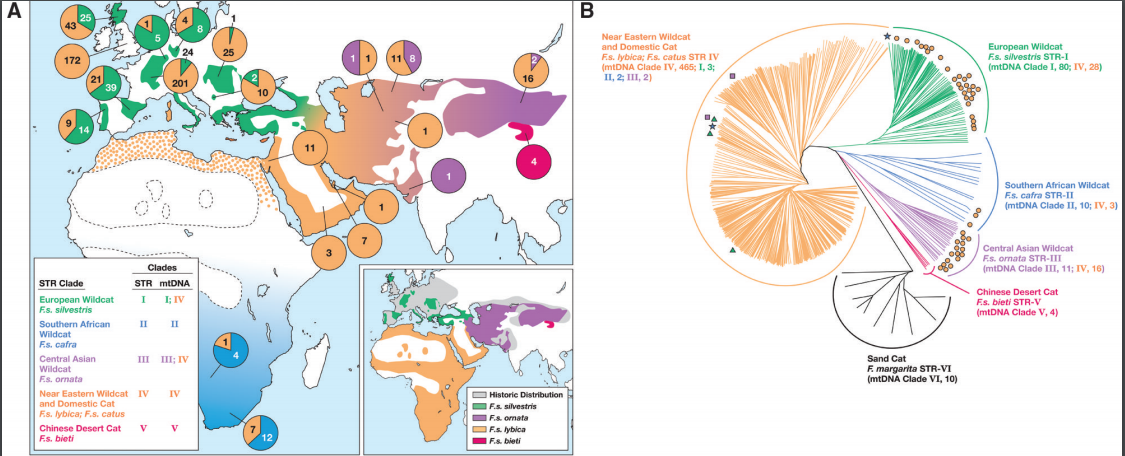
Driscoll, C. A., M. Menotti-Raymond, A.L. Roca, K. Hupe, W.E. Johnson, E. Geffen, E.H. Harley, M. Delibes, D.Pontier, A.C. Kitchener, N. Yamaguchi, S.J. O'Brien, & D.W. Macdonald (2007). The Near Eastern origin of cat domestication. Science, 317(5837), 519-523.

The world's domestic cats carry patterns of sequence variation in their genome that reflect a history of domestication and breed development. A genetic assessment of 979 domestic cats and their wild progenitors—Felis silvestris silvestris (European wildcat), F. s. lybica (Near Eastern wildcat), F. s. ornata (central Asian wildcat), F. s. cafra (southern African wildcat), and F. s. bieti (Chinese desert cat)—indicated that each wild group represents a distinctive subspecies of Felis silvestris. Further analysis revealed that cats were domesticated in the Near East, probably coincident with agricultural village development in the Fertile Crescent. Domestic cats derive from at least five founders from across this region, whose descendants were transported across the world by human assistance.
http://www.mobot.org/plantscience/resbot/Repr/Add/DomesticCat_Driscoll2007.pdf


Driscoll, C. A., Clutton-Brock, J., Kitchener, A. C., & O'Brien, S. J. (2009). The taming of the cat. Scientific American, 300(6), 68-75.

KEY CONCEPTS
  • Unlike other domesticated creatures, the house cat contributes little to human survival. Researchers have therefore wondered how and why cats came to live among people. Experts traditionally thought that the Egyptians were the first to domesticate the cat, some 3,600 years ago. 
  • But recent genetic and archaeological discoveries indicate that cat domestication began in the Fertile Crescent, perhaps around 10,000 years ago, when agriculture was getting under way. 
  • The findings suggest that cats started making themselves at home around people to take advantage of the mice and food scraps found in their settlements. 

Saturday, 12 April 2014

Prevalence of T. gondii depends on household effect

Fromont, E. G., Riche, B., & Rabilloud, M. (2009). Toxoplasma seroprevalence in a rural population in France: detection of a household effect. BMC infectious diseases, 9(1), 76.


Background

Toxoplasma gondii, the agent of toxoplasmosis, has a complex life cycle. In humans, the parasite may be acquired either through ingestion of contaminated meat or through oocysts present in the environment. The importance of each source of contamination varies locally according to the environment characteristics and to differences concerning human eating habits and the presence of cats; thus, the risk factors may be determined through fine-scale studies. Here, we searched for factors associated with seropositivity in the population of two adjacent villages in Lorraine region, France.

Methods
All voluntary inhabitants filled out a questionnaire and gave a blood sample. The seroprevalence was estimated globally and according to the inhabitants' ages using a cubic spline regression. A mixed logistic regression model was used to quantify the effect of individual and household factors on the probability of seropositivity.
Results

Based on serological results from 273 persons, we estimated seroprevalence to be 47% (95% confidence interval: 41 to 53%). That seroprevalence increased with age: the slope was the steepest up to the age of 40 years (OR = 2.48 per 10-year increment, 95% credibility interval: [1.29 to 5.09]), but that increase was not significant afterwards. The probability of seropositivity tended to be higher in men than in women (OR = 2.01, 95% credibility interval: [0.92 to 4.72]) and in subjects eating raw vegetables at least once a week than in the others (OR = 8.4, 95% credibility interval: [0.93 to 72.1]). These effects were close to statistical significance. The multivariable analysis highlighted a significant seroprevalence heterogeneity among households. That seroprevalence varied between 6 and 91% (5th and 95th percentile of the household seropositivity distribution).
ConclusionThe major finding is the household effect, with a strong heterogeneity of seroprevalence among households. This effect may be explained by common exposures of household members to local risk factors. Future work will quantify the link between the presence of oocysts in the soil and the seroprevalence of exposed households using a spatial analysis.

Tuesday, 11 February 2014

Cat predation on Yelkouan shearwater

Bonnaud, E., Bourgeois, K., Vidal, E., Legrand, J., & Le Corre, M. (2009). How can the Yelkouan shearwater survive feral cat predation? A meta-population structure as a solution?. Population ecology, 51(2), 261-270.

The Yelkouan shearwater, Puffinus yelkouan, is an endangered Mediterranean endemic species of burrowing petrel threatened by feral cats. The life-history parameters of a small population of Yelkouan shearwaters on the Mediterranean island, Port-Cros, were studied in conjunction with the diet of feral cats, to examine the birds’ vulnerability to introduced cats. Yelkouan shearwaters were the birds most frequently found in cat scats, with 431 ± 72 birds killed per year, and predation highest during the pre-laying period. A demographic model was created using data for P. yelkouan and for closely related shearwater species. Without cat predation, only two of four survival rate scenarios led to a mean growth rate (λ) ≥ 1. The model was constrained to have a stable population growth rate and used to predict predation scenarios compatible with the observed population stability, because the population under study has remained stable at around 180 pairs for at least 20 years despite feral cat predation. The results of assuming that the population is closed were inconsistent with the estimated mortalities due to feral cats, while it was possible to reconcile the observed numbers of breeding pairs with the observed mortalities due to cats by assuming that Port-Cros Island is a sink sustained by immigration. This illustrates that small colonies may need to be sustained by larger ones to avoid being driven to extinction. Unfortunately, the absence of a large geographic-scale ringing program makes the precise identification of the origin of the immigrants impossible in this case.

Saturday, 8 February 2014

Self-domestication of cats and dogs

Driscoll, C. A., Macdonald, D. W., & O'Brien, S. J. (2009). From wild animals to domestic pets, an evolutionary view of domestication. Proceedings of the National Academy of Sciences, 106(Supplement 1), 9971-9978.

Artificial selection is the selection of advantageous natural variation for human ends and is the mechanism by which most domestic species evolved. Most domesticates have their origin in one of a few historic centers of domestication as farm animals. Two notable exceptions are cats and dogs. Wolf domestication was initiated late in the Mesolithic when humans were nomadic hunter-gatherers. Those wolves less afraid of humans scavenged nomadic hunting camps and over time developed utility, initially as guards warning of approaching animals or other nomadic bands and soon thereafter as hunters, an attribute tuned by artificial selection. The first domestic cats had limited utility and initiated their domestication among the earliest agricultural Neolithic settlements in the Near East. Wildcat domestication occurred through a self-selective process in which behavioral reproductive isolation evolved as a correlated character of assortative mating coupled to habitat choice for urban environments. Eurasian wildcats initiated domestication and their evolution to companion animals was initially a process of natural, rather than artificial, selection over time driven during their sympatry with forbear wildcats.

Wednesday, 8 January 2014

Wild or feral cats in NE France

O’Brien, J., Devillard, S., Say, L., Vanthomme, H., Léger, F., Ruette, S., Pontier, D., 2009. Preserving genetic integrity in a hybridising world: are European Wildcats (Felis silvestris silvestris) in eastern France distinct from sympatric feral domestic cats? Biodiversity Conservation, 18, 2351–2360.

We investigate the genetic profile of putative European Wildcats in north-eastern France, possessing the wildcat phenotype, but sampled in an area where they are sympatric with free-roaming domestic cats and, thus, are exposed to potential hybridisation. From a sample of 209 cats, the programme STRUCTURE clearly identified two distinct genetic clusters that corresponded to European Wildcats and domestic cats. The cats from these two clusters were clearly differentiated from each other (F ST = 0.16). However, the genotypes of some individual cats were split between the two clusters, indicative of genetic admixture. Our analysis demonstrates that a genetically distinct population of cats that possess the European Wildcat phenotype persists in north-eastern France, but that there is a low, yet real, risk of hybridisation with sympatric domestic cats. These European Wildcats warrant conservation efforts to protect their genetic integrity.

See more on domestic cat introgression in wildcat


Cat hybridization in Germany

Krüger, M., Hertwig, S. T., Jetschke, G., & Fischer, M. S. (2009). Evaluation of anatomical characters and the question of hybridization with domestic cats in the wildcat population of Thuringia, Germany. Journal of Zoological Systematics and Evolutionary Research, 47(3), 268-282.

Germany’s large population of wildcats (Felis silvestris silvestris) can be clearly distinguished from domestic cats on the basis of morphological characters. However, an examination of 71 specimens from Thuringia also illustrates the risks involved in using only a few such characters. The most reliable tool for identification in the field are three pelage characters (distinctness of tail bands, stripes on the nape and stripes on the shoulder). Only two morphological characters (intestine length and cranial volume) are unambiguous and demonstrate no overlap in distribution between domestic cats and wildcats. A linear discriminant analysis with forward selection of variables showed that only five skull variables are necessary to distinguish all four groups (subspecies × sex). Additionally, the high degree of correlation between most of the 49 variables examined (as indicated by Pearson’s r correlation matrix) speaks against the utility of measuring such high numbers of characters in the future. Principal component analysis (PCA) enabled the subspecies to be separated clearly. The first PCA axis was highly correlated with variables characterizing overall body size, thus separating male and female into wildcats and domestic cats. Even when the chief differentiating characters are missing, the PCA still resulted in a good separation of subspecies. None of the genetically determined hybrids could have been deciphered unambiguously using the morphological characters still intact after a road death. Hybridization seems to occur whenever wildcats change their ecological function and become field cats. The impulse to hybridize seems to come much more from the wildcat side than the side of feral cats, and deforestation represents the major threat to the wildcat.


Hertwig, S. T., Schweizer, M., Stepanow, S., Jungnickel, A., Böhle, U. R., & Fischer, M. S. (2009). Regionally high rates of hybridization and introgression in German wildcat populations (Felis silvestris, Carnivora, Felidae). Journal of Zoological Systematics and Evolutionary Research, 47(3), 283-297.

While the western populations of the wildcat (Felis silvestris silvestris) in Germany come into contact with wildcats in France and Switzerland, the eastern distribution area is geographically completely isolated and consists of scattered subpopulations. To investigate population structure, evolutionary relationships and degree of hybridization with domestic cats we analysed the mitochondrial control region of 86 cats in combination with 11 microsatellite loci of 149 cats. According to our microsatellite data, German wildcats are divided into two separate populations corresponding to the western and eastern distribution areas. We found no indication of a further subdivision of the eastern population. German wildcat populations are genetically distinct from domestic cats in the main, but we identified 18.4% of the whole wildcat sample as being of hybrid origin, corresponding to 4.2% of the eastern and 42.9% of the western wildcat population, and 2.7% of the domestic cat sample. The mitochondrial haplotypes form a network of three connected clusters and reveal a high level of genetic diversity, especially within the eastern population. Our findings are explained at best in terms of continuous introgression between domestic cats and wildcat populations and differing degrees of recent hybridization in the various populations. Future conservation efforts should focus on preserving the existing gene flow between the isolated distribution areas, but also on preventing the spread of hybrids and limiting the habitat alterations that lead to increased contact with domestic cats. In conclusion we discuss possible evolutionary reasons for the still traceable genetic integrity of the wildcat despite its long history of interbreeding.


See more on domestic cat introgression in wildcat


Tuesday, 7 January 2014

Demographic Cat–Rat interactions in an urban environment.

Glass GE, Gardner-Santana LC, Holt RD, Chen J, Shields TM, Roy M, Schachterle S & Klein SL (2009) Trophic Garnishes: Cat–Rat Interactions in an Urban Environment. PLoS ONE 4(6): e5794. doi:10.1371/journal.pone.0005794

Background

Community interactions can produce complex dynamics with counterintuitive responses. Synanthropic community members are of increasing practical interest for their effects on biodiversity and public health. Most studies incorporating introduced species have been performed on islands where they may pose a risk to the native fauna. Few have examined their interactions in urban environments where they represent the majority of species. We characterized house cat (Felis catus) predation on wild Norway rats (Rattus norvegicus), and its population effects in an urban area as a model system. Three aspects of predation likely to influence population dynamics were examined; the stratum of the prey population killed by predators, the intensity of the predation, and the size of the predator population.

Methodology/Principal Findings
Predation pressure was estimated from the sizes of the rat and cat populations, and the characteristics of rats killed in 20 alleys. Short and long term responses of rat population to perturbations were examined by removal trapping. Perturbations removed an average of 56% of the rats/alley but had no negative long-term impact on the size of the rat population (49.6±12.5 rats/alley and 123.8±42.2 rats/alley over two years). The sizes of the cat population during two years (3.5 animals/alley and 2.7 animals/alley) also were unaffected by rat population perturbations. Predation by cats occurred in 9/20 alleys. Predated rats were predominantly juveniles and significantly smaller (144.6 g±17.8 g) than the trapped rats (385.0 g±135.6 g). Cats rarely preyed on the larger, older portion of the rat population.
Conclusions/Significance
The rat population appears resilient to perturbation from even substantial population reduction using targeted removal. In this area there is a relatively low population density of cats and they only occasionally prey on the rat population. This occasional predation primarily removes the juvenile proportion of the rat population. The top predator in this urban ecosystem appears to have little impact on the size of the prey population, and similarly, reduction in rat populations doesn't impact the size of the cat population. However, the selected targeting of small rats may locally influence the size structure of the population which may have consequences for patterns of pathogen transmission.

Monday, 6 January 2014

Incursion of domestic carnivores around urban areas: Three camera-trapping studies

Marks, B. K., & Duncan, R. S. (2009). Use of forest edges by free-ranging cats and dogs in an urban forest fragment. Southeastern Naturalist8(3), 427-436.

Free-ranging Felis catus (Domestic Cat) and Canis familiaris (Domestic Dog) can greatly impact native prey populations, but little is known about their occurrence in urban forest fragments. In this study, we used camera traps to photograph (capture) cats, dogs, and native wildlife in a 409-ha urban forest in Birmingham, AL from Jan–Apr 2007. Habitat treatments included forest interior and forest edges by industrial lands, neighborhoods with higher house values, and neighborhoods with lower house values. We employed both conservative (n = 31) and liberal (n = 64) methods of tallying the number of individual dogs, cats, and native mammals captured. Dogs and cats combined comprised 19% (conservative) and 26% (liberal) of all photographic captures. Procyon lotor (Raccoon) were the most abundant of the 7 native species at 32% (conservative) and 53% (liberal) of all captures. Dogs were more abundant in neighborhood edges, and cats were more abundant in the forest interior. Cats and dogs combined were 75% (conservative) and 86% (liberal) of captures from the forest interior. Captures of native species were far more frequent in neighborhood edges (conservative = 86.9%, and liberal = 92.3%) than in other treatments. These findings demonstrate that exotic predators can be an important ecological presence in certain portions of urban forest fragments, and more extensive studies of their impact are needed.

Ordeñana, M.A, K. R. Crooks, E.E. Boydston, R.N. Fisher, L.M. Lyren, S. Siudyla, C.D. Haas, S. Harris, S.A. Hathaway, G.M. Turschak, A. K. Miles, & D.H. Van Vuren (2010) Effects of urbanization on carnivore species distribution and richness. Journal of Mammalogy, 91 (6): 1322-1331.

Urban development can have multiple effects on mammalian carnivore communities. We conducted a meta-analysis of 7,929 photographs from 217 localities in 11 camera-trap studies across coastal southern California to describe habitat use and determine the effects of urban proximity (distance to urban edge) and intensity (percentage of area urbanized) on carnivore occurrence and species richness in natural habitats close to the urban boundary. Coyotes (Canis latrans) and bobcats (Lynx rufus) were distributed widely across the region. Domestic dogs (Canis lupus familiaris), striped skunks (Mephitis mephitis), raccoons (Procyon lotor), gray foxes (Urocyon cinereoargenteus), mountain lions (Puma concolor), and Virginia opossums (Didelphis virginiana) were detected less frequently, and long-tailed weasels (Mustela frenata), American badgers (Taxidea taxus), western spotted skunks (Spilogale gracilis), and domestic cats (Felis catus) were detected rarely. Habitat use generally reflected availability for most species. Coyote and raccoon occurrence increased with both proximity to and intensity of urbanization, whereas bobcat, gray fox, and mountain lion occurrence decreased with urban proximity and intensity. Domestic dogs and Virginia opossums exhibited positive and weak negative relationships, respectively, with urban intensity but were unaffected by urban proximity. Striped skunk occurrence increased with urban proximity but decreased with urban intensity. Native species richness was negatively associated with urban intensity but not urban proximity, probably because of the stronger negative response of individual species to urban intensity.

Fandos, G., Fernández-López, J., & Tellería, J. L. (2012). Incursion of domestic carnivores around urban areas: a test in central Spain. Mammalia, 76(2), 223-225.

Although domestic carnivores are frequently considered a threat to wildlife inside and around urban areas, little is known about the incursions of these animals from urban areas to the surrounding habitats. To explore this, we sampled carnivores in wooded areas surrounding four villages located in the mountains north of Madrid by using 40 camera-trapping stations. They were distributed at regular distances within a perpendicular transect distributed from 10 to 2000 m from the urban border. The results suggest that the incidence of domestic carnivores (cats and dogs) was constrained to <400 m from the urban border, and that the presence of domestic carnivores did not interfere with the distribution of wild carnivores (foxes, beech martens, badgers, genets, etc.), which show random distribution patterns around villages. This means that overpredation at the village edges could mainly be due to the effect of domestic animals and not to that of wild carnivores attracted to urban areas


Saturday, 7 December 2013

Dogs limit Fosa populations in Madagascar

Barcala, O. (2009). Invasive Stray and Feral Dogs Limit Fosa (Cryptoprocta ferox) Populations in Ankarafantsika National Park, Madagascar (Doctoral dissertation, Duke University).

The fosa (Cryptoprocta ferox) is a medium sized carnivore of the family Eupleridae which is endemic to the island of Madagascar. Recent publications have shown that the fosa is under significant pressure from deforestation and fragmentation, leading to its classification as Threatened under the Endangered Species Act. A trap study was conducted from 1999 to 2008 in Ankarafantsika National Park, Madagascar, to ascertain the health of a population and measure additional threats to its survival. Feral dogs (Canis lupus familiaris) appeared in the park in 2004 and a comparison of trap rates of the two species shows an inverse relationship between the presence of dogs and the presence of fosa. In this paper I discuss reasons for this relationship, the effect of the continued presence of dogs, and implications for the management of the park.
Related Posts Plugin for WordPress, Blogger...